
M Jackson
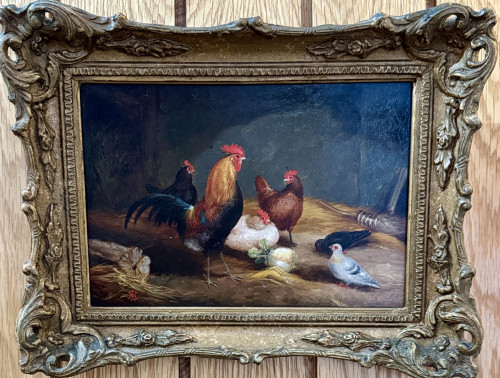
M. Jackson (English School, late 19th Century)
Chickens in a Hen House
Oil on board, circa 1890
Monogrammed lower left
This charming late Victorian farmyard scene captures the quiet beauty of rural life through an intimate portrayal of a proud cockerel and his small flock within the warm interior of a traditional English hen house. Painted around 1890, the work reflects the enduring popularity of domestic poultry subjects during the latter half of the nineteenth century, when artists celebrated the simple pleasures and timeless rhythms of country living with remarkable sensitivity and technical skill.
At the centre of the composition stands a magnificent cockerel, his rich plumage brilliantly illuminated against the subdued interior. His striking crimson comb and iridescent tail feathers immediately command the viewer's attention, while a gathering of attentive hens forms a harmonious circle around freshly scattered vegetables and grain. A pair of pigeons adds further interest to the foreground, introducing subtle movement and colour, while the soft straw-covered floor, rustic timbers and shadowed interior evoke the atmosphere of a well-kept Victorian farmstead.
The artist demonstrates a confident understanding of both avian anatomy and natural behaviour. Each bird possesses its own distinct character, from the watchful stance of the dominant cockerel to the quietly feeding hens and the inquisitive pigeons exploring the barn floor. The restrained palette of warm earth tones is enlivened by flashes of vibrant reds, golds and deep iridescent blues, while the careful use of light emerging from the darker background creates depth and dramatic contrast. This interplay of illumination recalls
M. Jackson (English School, late 19th Century)
Chickens in a Hen House
Oil on board, circa 1890
Monogrammed lower left
This charming late Victorian farmyard scene captures the quiet beauty of rural life through an intimate portrayal of a proud cockerel and his small flock within the warm interior of a traditional English hen house. Painted around 1890, the work reflects the enduring popularity of domestic poultry subjects during the latter half of the nineteenth century, when artists celebrated the simple pleasures and timeless rhythms of country living with remarkable sensitivity and technical skill.
At the centre of the composition stands a magnificent cockerel, his rich plumage brilliantly illuminated against the subdued interior. His striking crimson comb and iridescent tail feathers immediately command the viewer's attention, while a gathering of attentive hens forms a harmonious circle around freshly scattered vegetables and grain. A pair of pigeons adds further interest to the foreground, introducing subtle movement and colour, while the soft straw-covered floor, rustic timbers and shadowed interior evoke the atmosphere of a well-kept Victorian farmstead.
The artist demonstrates a confident understanding of both avian anatomy and natural behaviour. Each bird possesses its own distinct character, from the watchful stance of the dominant cockerel to the quietly feeding hens and the inquisitive pigeons exploring the barn floor. The restrained palette of warm earth tones is enlivened by flashes of vibrant reds, golds and deep iridescent blues, while the careful use of light emerging from the darker background creates depth and dramatic contrast. This interplay of illumination recalls
the influence of earlier Dutch and Flemish animal painters, whose works continued to inspire British sporting and farmyard artists throughout the nineteenth century.
Although little is recorded about the monogrammist M. Jackson, the painting displays the accomplished technique associated with the English sporting and animal painting tradition that flourished during the Victorian period. Collectors of the era greatly admired such works, not only for their decorative qualities but also for their celebration of Britain's agricultural heritage and rural prosperity.
Beautifully preserved and presented in an ornate period gilt frame that complements its Victorian character, this delightful oil on board is an excellent example of late nineteenth-century English animal painting. Combining strong decorative appeal with a finely observed depiction of rural life, it would make a charming addition to any collection of traditional British sporting, agricultural or country house paintings.
1 ITEM
